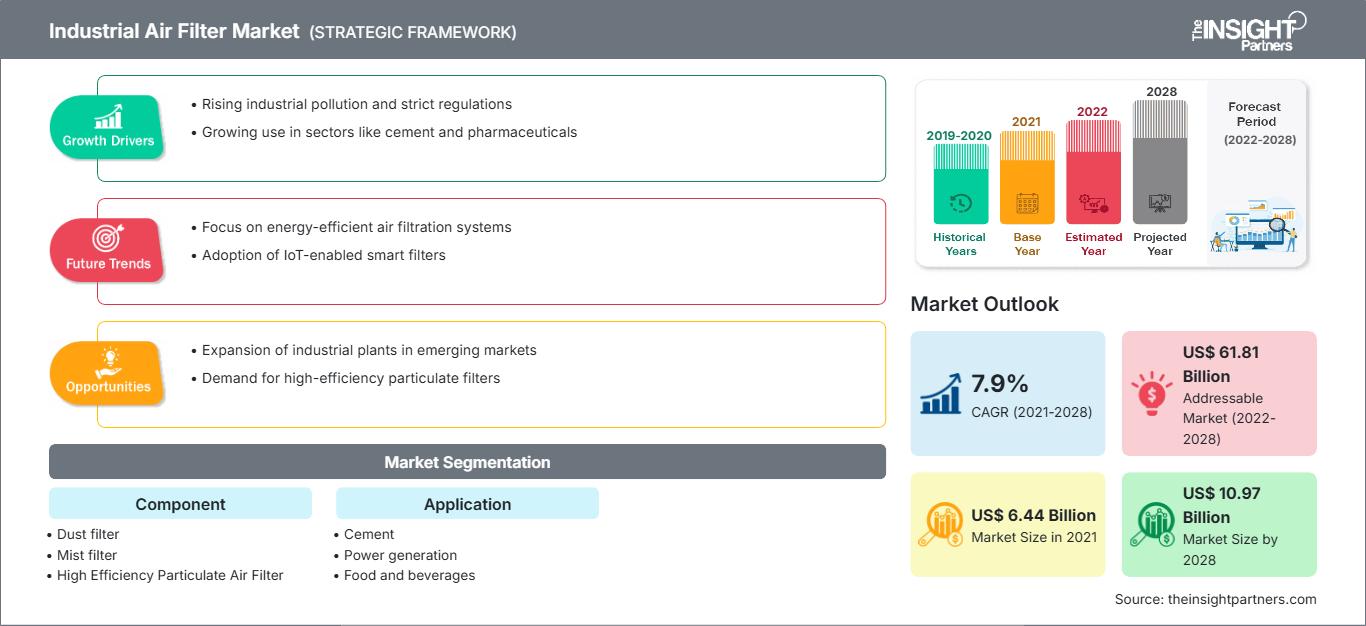
New York, Feb. 24, 2026 (GLOBE NEWSWIRE) -- The Global Industrial Air Filters Market is poised for steady expansion, driven by rapid industrialization, tightening environmental regulations, and growing awareness of occupational health and indoor air quality. According to a newly published market research report by The Insight Partners, the market is projected to grow from USD 13.14 billion in 2024 to USD 20.51 billion by 2031, registering a CAGR of 6.7% during 2025–2031.
Industrial air filtration systems have become mission-critical infrastructure across manufacturing, chemicals, petrochemicals, power generation, mining, pharmaceuticals, and food processing industries. As regulatory scrutiny intensifies and production volumes increase globally, the demand for advanced filtration technologies continues to accelerate.
- Market Size 2024: USD 13.14 Billion
- Projected Market Size 2031: USD 20.51 Billion
- CAGR (2025–2031): 6.7%
- Fastest Growing Region: Asia Pacific
- Leading Material Segment: Non-Woven Fabrics
- Highest Growth Material: Fiberglass
The upward trajectory reflects a broad industrial recovery and structural transformation toward cleaner, more sustainable operations.
To explore the valuable insights in the Industrial air filters market report, you can easily download a sample PDF of the report - https://www.theinsightpartners.com/sample/TIPRE00005294
Key Growth Driver: Global Industrial Expansion & Manufacturing Recovery
According to the 29th Edition of the International Yearbook of Industrial Statistics (2023), global industrial sectors recorded 2.3% growth, signaling continued post-pandemic recovery. Manufacturing led the expansion with 3.2% growth, supported by higher production in:
- Automotive
- Cement
- Chemicals
- Metals
- Electronics
- Energy and utilities
As factories scale production, airborne contaminants such as dust, chemical vapors, fumes, smoke, and particulate matter increase proportionally. Industrial air filtration systems are essential for:
- Emission control
- Compliance with air quality norms
- Protection of sensitive manufacturing equipment
- Ensuring worker health and safety
Stricter environmental frameworks, including the Clean Air Act, and standards enforced by agencies such as the Environmental Protection Agency (EPA) and Occupational Safety and Health Administration (OSHA), are accelerating adoption in developed economies.
Market Trends Reshaping Industrial Air Filtration
- Advanced Filtration Media Innovation
Modern industrial facilities are transitioning from conventional filters to high-performance systems such as:
- HEPA (High Efficiency Particulate Air)
- ULPA (Ultra Low Penetration Air)
- Electrostatic precipitators
- Activated carbon filters
- Nanofiber-enhanced media
Emerging technologies include:
- Multi-layer composite structures
- Antimicrobial coatings
- Self-cleaning filters
- Pleated high-surface-area designs
These innovations improve:
- Dust loading capacity
- Energy efficiency
- Airflow stability
- Lifecycle cost performance
Check Updates on the Latest Study Industrial Air Filters Market Trends:
https://www.theinsightpartners.com/sample/TIPRE00005294
Segmentation Analysis: Industrial Air Filters Market
- By Filter Media
Non-Woven Fabric Filters – Largest Market Share
Non-woven fabrics dominate due to:
- Lightweight structure
- High dust-holding capacity
- Versatility in HVAC, manufacturing, and cleanrooms
- Compatibility with nanofiber and activated carbon treatments
Their efficiency, flexibility, and cost-effectiveness make them ideal across industries requiring continuous air purification.
Fiberglass Filters – Highest CAGR (6.7%)
Fiberglass filters are witnessing the fastest growth owing to:
- Superior heat resistance
- Large dust capacity
- Resistance to harsh industrial environments
- Longevity and reduced replacement cycles
Strategic industry collaboration is also accelerating innovation. For example, in December 2024, Harbin ROPV Industrial Co. Ltd partnered with Impact Filtration Inc. to expand fiberglass-reinforced filtration offerings.
- By Industry Vertical
Chemicals & Petrochemicals – Largest Adopter
Chemical and petrochemical plants rely heavily on advanced air filtration technologies to:
- Control hazardous emissions
- Prevent catalyst contamination
- Protect instruments and processing equipment
- Maintain regulatory compliance
High-efficiency systems like HEPA and electrostatic filters ensure environmental safety while reducing operational risks.
Regional refinery upgrades and stricter emission mandates across Asia Pacific, the Middle East, and North America are bolstering demand in this sector.
Ask for more details of the Global Industrial Air Filters Market Size and Growth Report (2025-2031) at: https://www.theinsightpartners.com/inquiry/TIPRE00005294
Regional Analysis: Asia Pacific to Lead Future Growth
Asia Pacific is projected to register the fastest CAGR during the forecast period.
The region faces severe air pollution challenges. According to global health data, approximately 6.5 million deaths annually are linked to poor air quality, with nearly 70% occurring in Asia Pacific.
Contributing factors include:
- Rapid urbanization
- Expanding industrial base
- Growing energy consumption
- Rising automotive output
Major pollutants include:
- PM2.5 and PM10
- Volatile Organic Compounds (VOCs)
- Industrial emissions
Governments are addressing air quality concerns through initiatives such as:
- Asia Pacific Clean Air Partnership
- Acid Deposition Monitoring Network in East Asia
As compliance mechanisms strengthen, industries are investing significantly in advanced air filtration infrastructure.
Market Dynamics
Driver: Stringent Government Regulations
Environmental regulations worldwide are becoming increasingly strict. Governments mandate emission control systems in industries such as:
- Steel and cement
- Pharmaceuticals
- Food & beverage
- Power generation
- Mining
Compliance with national emission standards and workplace safety norms is no longer optional, making air filtration systems critical capital investments.
Opportunity: Smart & IoT-Enabled Air Filtration Systems
The integration of IoT technology into industrial filtration is transforming the market.
Smart filters now feature:
- Real-time particulate monitoring
- Pressure differential sensors
- Predictive maintenance alerts
- Automated performance analytics
These systems allow:
- Reduced downtime
- Lower maintenance costs
- Enhanced energy optimization
- Extended filter life
The shift toward Industry 4.0 and smart manufacturing is unlocking new revenue streams in digital filtration monitoring solutions.
⚠️ Challenge: High Operating Costs & Energy Consumption
Despite growth opportunities, challenges remain:
- High initial capital investment
- Increased pressure drop in high-efficiency filters
- Energy consumption constraints
- Maintenance downtime
Small and mid-sized manufacturers may delay upgrades due to budget limitations. Furthermore, poor system design can affect efficiency and lifecycle performance.
Balancing filtration performance and energy efficiency remains a key engineering challenge.
Competitive Landscape: Leading Industrial Air Filter Companies
The market is moderately consolidated, with key players investing in acquisitions, product innovation, and geographic expansion.
Major Companies Include:
- MANN+HUMMEL International GmbH & Co. KG
- Alfa Laval AB
- Parker Hannifin Corporation
- Eaton Corporation plc
- HYDAC International GmbH
- Donaldson Company, Inc.
- Hollingsworth & Vose Co
- Filtcare Technology Pvt. Ltd
Recent Industry Developments
- November 2025: Parker Hannifin Corporation announced a definitive agreement to acquire Filtration Group Corporation for USD 9.25 billion, strengthening its filtration portfolio.
- October 2025: Donaldson Company, Inc. opened a new distribution center in Olive Branch, Mississippi, enhancing supply chain capabilities in mobile solutions and industrial filtration segments.
These developments signal strong consolidation and long-term strategic investment across the industrial air filter ecosystem.
Why Industrial Air Filters Are Becoming Mission-Critical Infrastructure
Industrial air filters are no longer optional compliance tools — they are strategic operational assets. They help industries:
- Reduce environmental footprint
- Improve energy efficiency
- Extend machinery lifespan
- Safeguard workforce health
- Avoid regulatory penalties
- Support ESG and sustainability initiatives
As industries transition toward carbon neutrality and cleaner production models, air filtration will remain a core enabler of sustainable industrial development.
Purchase Premium Copy of Global Industrial Air Filters Market Size and Growth Report (2025-2031) at: https://www.theinsightpartners.com/buy/TIPRE00005294
About The Insight Partners
The Insight Partners is a global market research and consulting firm providing in-depth industry analysis and data-driven insights across technology, healthcare, telecom, automotive, energy, and industrial sectors. The firm empowers organizations with strategic intelligence to navigate market disruptions, identify growth opportunities, and make informed business decisions.
Frequently Asked Questions (FAQs)
Q1. What is driving the Industrial Air Filters Market growth?
Stringent environmental regulations, industrial expansion, rising pollution levels, and increasing awareness of worker safety are key growth drivers.
Q2. Which region is growing fastest?
Asia Pacific is expected to register the highest CAGR due to industrialization and regulatory tightening.
Q3. Which filter type dominates the market?
Non-woven fabric filters hold the largest market share, while fiberglass filters show the fastest growth.
Q4. What is the projected market size by 2031?
The market is expected to reach USD 20.51 billion by 2031.
Conclusion
The Global Industrial Air Filters Market is entering a sustained growth phase, fuelled by industrial modernization, environmental accountability, and technological transformation. As global regulations tighten and pollution concerns intensify, advanced air filtration systems will remain a cornerstone of industrial infrastructure worldwide.
For detailed market insights, competitive analysis, segmentation data, and strategic forecasts, the complete Industrial Air Filters Market report by The Insight Partners provides comprehensive industry coverage through 2031.
Related Reports:
- Industrial Liquid Filters Market Forecast to 2031 | Size and Share
- Industrial Filters Market Size, Growth Trends & Top Players Analysis to 2031
- Hydraulic Filters Market Segments and Growth by 2031
- Spin Filters Market Trends and Research Report (2021-2034)
- High Pass Filters Market Size, Share, and Growth Analysis by 2031
- Common Mode Filters Market Trends, Growth and Size - 2034

Contact Us:
If you have any queries about this report or if you would like further information, please contact us:
Contact Person: Ankit Mathur
E-mail: sales@theinsightpartners.com
Phone: +1-646-491-9876