RepRisk report reveals banks exposed to more frequent, complex, and costly business conduct risk incidents and surge in AI-driven issues
PR Newswire
ZURICH, March 18, 2026
The Business Conduct Risk Intelligence Report 2026, published by RepRisk, distils the views of global C-suite leaders in banks, asset managers, asset owners, and other financial institutions, exploring how they are adopting and embedding business conduct risk data across workflows in a shifting and increasingly complex risk landscape.
- 81% executives agree that business conduct risk data will be more valuable to their company in the next three years due to more complex risks that are on the horizon.
- Most companies reported an increase in investment in business conduct risk data in the last year, and 58% reported that they had increased spend following a major incident.
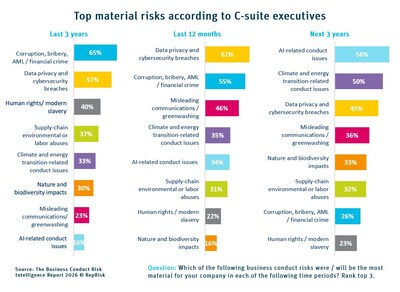
- While only 16% of executives identify AI‑related conduct risks as a top material risk over the last three years, this figure rises sharply to 56% for the next three years. This shift is mirrored in preferences for data providers: executives' trust in hybrid human–AI approaches is nearly double that of AI‑only providers (67% versus 35%).
ZURICH, March 18, 2026 /PRNewswire/ -- A new report published by RepRisk, the world's most respected DaaS provider for business conduct risks, in collaboration with Oxford Economics, reveals that major business conduct risks are rising sharply across the financial sector, driven by emerging risks such as AI, and climate and energy transition-related issues. Based on a survey of 500+ C-suite executives spanning Europe, the USA, and Asia, The Business Conduct Risk Intelligence Report 2026 finds that banks, asset managers, and other financial institutions are experiencing more frequent, complex, and costly incidents, resulting in multi-million USD costs to their bottom line.
Executives report that the average number of major business conduct risk incidents climbed by 55% between 2023 and 2025. In addition to direct financial costs, loss of key investors and clients, regulatory sanctions, and reputational brand damage emerged as the most common consequences, underscoring the high commercial stakes that banks and asset managers must navigate. As a result, business conduct incidents are no longer viewed as a compliance-only issue, but as a direct threat to commercial performance.
"As geopolitical and economic uncertainty intensifies and AI risks grow, trust is becoming a scarce asset," commented Philipp Aeby, CEO and Co-Founder at RepRisk. "In this fragile and dynamic environment, banks and asset managers must be able to trust their data. That means relevant, accurate, and timely data built on consistent, transparent methods that are traceable and stand up to audit. This is why leaders rely on hybrid human-AI risk intelligence – not black‑box automation – enabling them to explain, defend, and stand behind decisions at board level. Financial firms that treat business conduct risk data as a strategic capability, rather than a compliance afterthought, will be the ones that retain trust, resilience, and competitive advantage."
Marked shift in the top material business conduct risks led by AI-related conduct issues
Executives reported a marked shift in the top material risks with new issues expected to rise in materiality in the next three years. AI-related conduct issues, which were cited as the least material risk in the last three years, are anticipated to be the most material risk in three years. Climate and energy transition-related conduct issues have also climbed steeply to become the second most important anticipated issue. However, corruption & bribery issues, which were previously reported as one of the top two material risks, have dropped significantly, as have human rights and modern slavery issues, which have plunged from third place in the past three years to the lowest cited material risk for the next three years. Data privacy and cyber security breaches remain a prominent risk, along with misleading communications and greenwashing.
Accurate business conduct risk detection essential to navigate complex risk landscape
Approximately three in four executives indicated that business conduct risk data is essential to managing risk effectively. Prevention and early detection are now a business necessity, with leaders treating business conduct risk data as a strategic asset. Investing before crises strike is seen as key to building resilience and improving decision quality.
Business conduct risk data is already delivering business value, and its yields are set to rise as emerging risks intensify. Executives recognize that delaying investment in business conduct data raises long-term costs, strengthening the case for sustained, strategic funding. About 25% of institutions raised their conduct risk data investment by over 20% last year. However, most (58%) did so reactively, in the aftermath of a major incident.
Majority of leaders trust business conduct data based on hybrid human-AI approaches
The study explored executives' attitudes towards the different technological approaches providers use to generate business conduct data, specifically: AI-only, human-only, and hybrid human-AI. 73% of executives report using hybrid approaches, with 67% saying they trust hybrid data for material investment and risk decisions, compared with 35% for AI‑only approaches. Hybrid models are also rated highest across the quality dimensions that matter most for decision‑making, including relevance (65%), overall quality (63%), accuracy (60%), and traceability and transparency of methodology (57%).
By contrast, AI‑only approaches attract the highest levels of concern, particularly around false positives and false negatives (65%), lack of transparency, explainability, or auditability (62%), and inconsistent or opaque sources (60%). As AI-related conduct risks rise in materiality, the findings underline that financial institutions continue to favor decision‑grade data that combines advanced AI with expert human oversight, especially where accountability and explainability are critical.
Concerns around inconsistent or opaque sources and methodology changes that can break time series comparability, reinforce the importance of defensible, stable methods when data is used for monitoring and reporting over time. Human-only approaches raise different concerns. Speed of analysis and high cost are much more prominent, along with concerns about limited coverage or scale.
Notes to the Editor
- This research investigates how financial institutions are adopting and embedding business conduct risk data across workflows in a shifting and increasingly complex risk landscape. It focuses on the benefits of business conduct risk data and business leaders' unique views on external business conduct risk data providers and integration challenges.
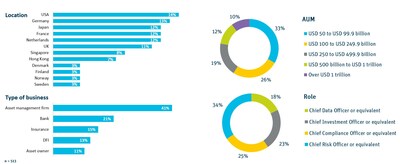
The study surveyed 513 C-suite executives from banks, asset managers, asset owners, and other financial institutions in Europe, the USA, and Asia, all with detailed oversight of their companies' business conduct risk strategies. The survey, commissioned by RepRisk in collaboration with Oxford Economics, was conducted in January 2026. Only companies that used external data to monitor business conduct risk were included in the sample. The survey results are reported at a 95% confidence level. Percentages may not sum to exactly 100% due to rounding. For more detail on the demographic breakdown, please see charts below.
About RepRisk
RepRisk is the world's most respected Data as a Service (DaaS) company for reputational risks and responsible business conduct. Since 2007, RepRisk's data has been trusted by the world's leading banks, investment managers, Fortune 500 companies, sovereign wealth funds, and organizations such as the OECD and UN. Combining advanced AI with deep human expertise, and a proven methodology at the core, RepRisk's solutions bring peace of mind, enabling clients to 'know more, be sure, and act faster'. Our pioneering solutions help to strengthen due diligence processes across business conduct topics, such as biodiversity, deforestation, human rights, and corruption, empowering clients to identify, monitor, and mitigate reputational, compliance, and financial risks. Headquartered in Zurich, and with offices in Toronto, New York, London, Berlin, Manila, and Tokyo, we stay close to clients and bring an independent lens to the industry. United by our shared belief in the power of data, our 400 people are proud to be setting the global standard for business conduct data and driving positive change through transparency. Visit us at reprisk.com and follow us on LinkedIn.
Photo - https://mma.prnewswire.com/media/2936403/reprisk_tbcrir_top_business_conduct_risks.jpg
Photo - https://mma.prnewswire.com/media/2936404/reprisk_tbcrir_demographic_breakdown.jpg
Logo - https://mma.prnewswire.com/media/2825086/5869585/reprisk_Logo.jpg

 View original content to download multimedia:https://www.prnewswire.com/news-releases/reprisk-report-reveals-banks-exposed-to-more-frequent-complex-and-costly-business-conduct-risk-incidents-and-surge-in-ai-driven-issues-302716559.html
SOURCE RepRisk

